
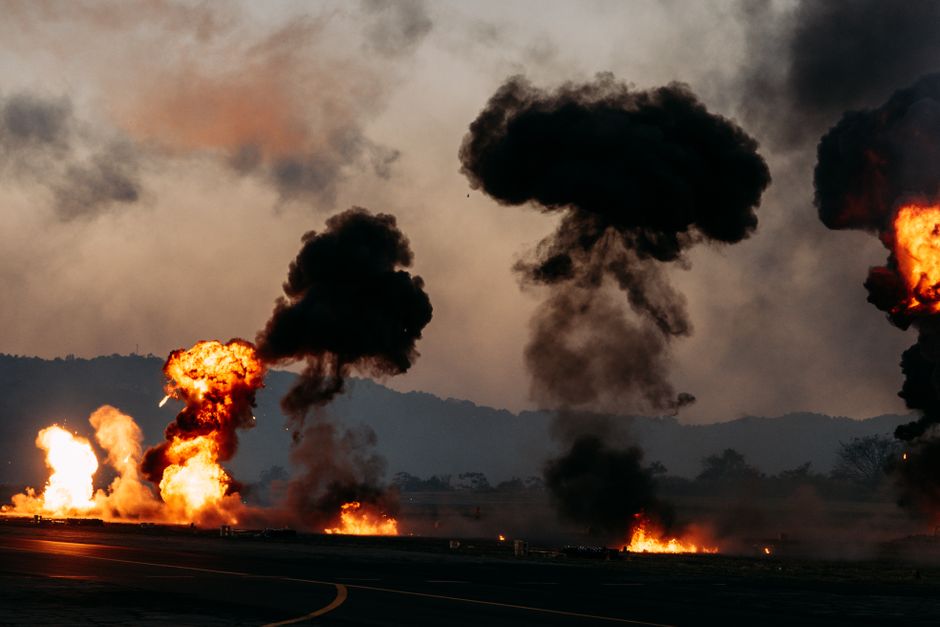
Explosions rocked the Syrian capital Damascus and surrounding countryside on Tuesday, April 7, 2026, as the Middle East faced mounting threats to civilian populations and regional stability amid an expanding conflict between Israel, the United States, and Iran.
Syrian state television reported the blasts, while Haaretz said the explosions were caused by Israeli air defenses intercepting Iranian missiles. The Times of Israel, citing Reuters, said the cause remained unknown at the time of reporting. The differing accounts underscored the confusion and information gaps that often accompany rapidly escalating military confrontations.
Civilian Populations Face Mounting Threats
The Damascus explosions occurred as the Israel Defense Forces assessed there could be increased fire toward Israel in the coming hours, with a US deadline for Iran to reopen the Strait of Hormuz set to expire at 8 p.m. EST on the same day. US President Donald Trump had warned that "a whole civilization will die tonight, never to be brought back again" if Iran did not agree to his demands by the deadline.
The threatening rhetoric prompted widespread alarm about the potential human cost of the conflict. Amy Spitalnick, CEO of the Jewish Council for Public Affairs, said in a statement: "We know what it means when leaders call for communities and populations to be wiped out. Any suggestion that this advances Jewish or Israeli safety is simply an exploitation of our community to advance horrific war crimes and the President's broader extreme anti-democratic agenda." She said people should recognize "multiple truths" that Iran's government is repressive and dangerous, and that the Trump administration is increasingly flouting its constitutional and humanitarian obligations.
International Calls for De-escalation
Pope Leo said threats against Iran were "unacceptable" and called on citizens across the world to contact their political representatives and ask them to bring the expanding regional conflict to an end. Pakistan's prime minister, Shehbaz Sharif, asked Trump to extend the Iran deadline by two weeks and called for a truce during that period, urging Tehran to open the Strait of Hormuz for the same period. Sharif said, "To allow diplomacy to run its course, I earnestly request President Trump to extend the deadline for two weeks," and, "Pakistan, in all sincerity, requests the Iranian brothers to open Strait of Hormuz for a corresponding period of two weeks as a goodwill gesture."
He also wrote, "We also urge all warring parties to observe a ceasefire everywhere for two weeks to allow diplomacy to achieve conclusive termination of war, in the interest of long-term peace and stability in the region," and said efforts to end the conflict were "progressing steadily, strongly and powerfully." The Times of Israel reported that White House press secretary Karoline Leavitt said Trump had been made aware of the request and that "A response will come."
Regional Security Deteriorates
The same day saw multiple security incidents across the region. Five explosions were heard in the center of Baghdad where the US embassy is located, and blasts were heard in the Qatari capital Doha while the UAE said its air defenses were responding to missile threats. The Emirati Ministry of Defense said on X, "The UAE's air defenses are currently dealing with missile and drone attacks coming from Iran."
The IDF said it was prepared to both defend and attack and would update the public if Home Front Command guidelines changed. First Vice President Mohammad Reza Aref wrote on X that Iran was prepared for all possibilities, saying, "National security and infrastructure sustainability are the subject of our precise calculations. The government has finalized the necessary measures in detail for all scenarios. No threat is beyond our preparedness and intelligence."
Why This Matters:
The Damascus explosions and accompanying threats to civilian populations illustrate how rapidly military escalation can endanger millions of ordinary people across the Middle East. When political leaders issue ultimatums threatening entire civilizations, the human cost becomes incalculable—affecting families, communities, and critical infrastructure that civilians depend on for survival. The calls for diplomatic extensions and ceasefires from religious leaders and regional powers reflect growing international alarm that the conflict is spiraling beyond the control of multilateral institutions designed to prevent mass civilian casualties. The differing accounts of what caused the Damascus blasts also highlight how information gaps during military confrontations can fuel further escalation, making transparent international oversight and diplomatic engagement essential to protecting vulnerable populations.