
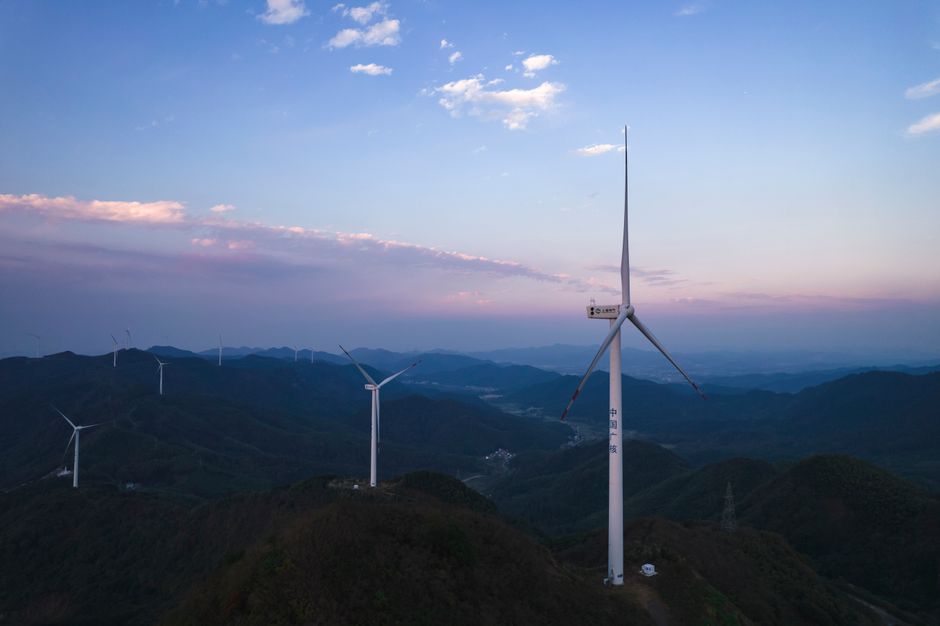
As a global energy crisis stemming from the Iran war deepens, China is consolidating its dominance in clean technologies—a shift that threatens to leave developing nations and Western economies scrambling to catch up in renewable energy markets.
The conflict, which began in late February, has disrupted fossil fuel supplies that once flowed reliably through the Strait of Hormuz to energy-dependent nations across Asia, Europe, and beyond. While gasoline prices spike in the U.S. and Europe, the real consequence is accelerating a technological and economic divide: countries facing energy insecurity are turning to Chinese manufacturers for the solar panels, batteries, and electric vehicles they need to transition away from volatile fossil fuel markets.
China's clean-tech exports hit a record of almost $22.3 billion in December, up about 47% from the year before, with much going to Southeast Asia and Europe, according to the think tank Ember. Industry giants like vehicle-maker BYD and battery-producer CATL are well-positioned to capitalize on growing interest in low-emissions energy products as the world confronts the fragility of fossil fuels. Investors are betting on the war's impact: in March, CATL and BYD's Hong Kong traded shares rose roughly 24% and 11%, respectively.
The Widening Energy Divide
Before the Iran war, the global energy landscape was already bifurcating along geopolitical lines. The U.S. under President Donald Trump scaled back on renewable energy and leaned on its vast oil and gas resources, promoting energy exports to achieve what Trump described as "energy dominance." Meanwhile, China had been steadily building unparalleled manufacturing capacity and export networks for clean technologies.
Sam Reynolds with the U.S.-based Institute for Energy Economics and Financial Analysis said, "China's approach to energy sector development and geopolitics has been completely validated by the Iran conflict."
This validation comes at a critical moment. Amy Myers Jaffe of New York University's Center for Global Affairs observed, "The energy shock is going to help the Chinese industry globally and hurt the American car industry globally." High U.S. tariffs have largely shut Chinese EVs out of the American market, but globally, the picture is starkly different. Chinese automakers were already expanding EV development and production while growing exports faster than American or European rivals, offering cheaper models and gaining ground in regions like Southeast Asia. These trends are expected to accelerate.
Who Faces the Steepest Costs
Developing nations dependent on energy imports are bearing the brunt of the crisis while having limited alternatives. Pakistan offers a stark example of both vulnerability and adaptation. About 80% of its oil flowed through the Strait of Hormuz, and Qatar had been supplying a quarter of its LNG. Yet Pakistan's renewable rollout, which began in 2017, had already positioned the nation to import Chinese solar panels—by December 2025, more than 50 gigawatts of Chinese panels had been deployed.
Nabiya Imran of Renewables First noted, "the shock isn't as big as it would have been without solar." If prices remain high, solar could save Pakistan $6.3 billion in fossil fuel imports over the next year, according to think tanks Renewables First and the Centre for Research on Energy and Clean Air. Yet this benefit comes with a cost: Pakistan's energy future is now deeply tied to Chinese technology and investment.
In the United Kingdom, EV leasing demand jumped by more than a third in the first three weeks of March compared to a similar period in February before the war, according to Octopus Energy, a renewable group. Octopus also reported increases in rooftop solar sales and solar-related inquiries. James Bowen of the Australia-based consultancy ReMap Research said, "Households facing higher energy costs are likely to move to clean power."
The Geopolitical Realignment
Investment in renewable power and battery storage is expected to increase in nations heavily dependent on energy imports, including European countries, according to the credit rating firm Fitch Ratings. Yet this transition is happening on terms largely set by Chinese manufacturers and investors.
Even Indonesia, the world's largest coal exporter, is recalibrating in ways that could deepen its dependence on Chinese technology. In March, Indonesian President Prabowo Subianto announced a push into EVs, including plans to produce electric cars and expand charging infrastructure. Chinese firms already play a major role in Indonesia's clean energy supply chain. They signed more than $54 billion dollars' worth of deals with the state utility in 2023 and added a $10 billion pledge during Prabowo's visit to Beijing in 2024.
Putra Adhiguna of the Jakarta-based think tank Energy Shift Institute said, "The dream of electrified transportation is gaining renewed attention." Reynolds added, "There will be direct financial benefits to Chinese companies."
In Southeast Asia, Vietnamese EV maker VinFast is offering discounts to offset fuel price shocks. Prolonged fuel spikes may act as a future catalyst for EVs, but according to Patrick Tan with the energy consultancy Aurora Research, it will take time to see the trend reflected in purchases, partly because customers are likely waiting to see how the conflict plays out.
Why This Matters:
The Iran war has accelerated a structural shift in global energy markets that raises fundamental questions about technological sovereignty and economic inequality. Developing nations facing energy insecurity are being forced to adopt clean technologies—a positive outcome—but on terms dictated by Chinese manufacturers and investors, potentially deepening technological and financial dependencies. Meanwhile, the divergence between U.S. energy policy prioritizing fossil fuel exports and China's clean-tech dominance means that countries seeking affordable renewable solutions have limited alternatives. The crisis demonstrates how energy security, climate transition, and geopolitical power are now inseparable. Without deliberate policy intervention to support diverse clean-tech manufacturing capacity and ensure equitable access to renewable technologies, the energy crisis risks entrenching global inequality while concentrating technological and economic power in a single nation.